Human intelligence,
unbound.
Through our work in politics, business and the media, and more recently with people at the forefront of artificial intelligence, we've found ourselves in an interesting position: understanding both what this technology is now capable of and why so few organisations are making anything like full use of it.
We believe the biggest barriers to AI adoption are no longer technological. They are human: understanding the possibilities, overcoming the fear of change and recognising the importance of owning what we build.
We believe the organisations that grasp these ideas first will have an extraordinary advantage over those that don't.
Here's how we think about it.
Your intelligence no longer has to be limited by your time.
The industrial revolution multiplied what our bodies could produce. AI can do the same for our minds.
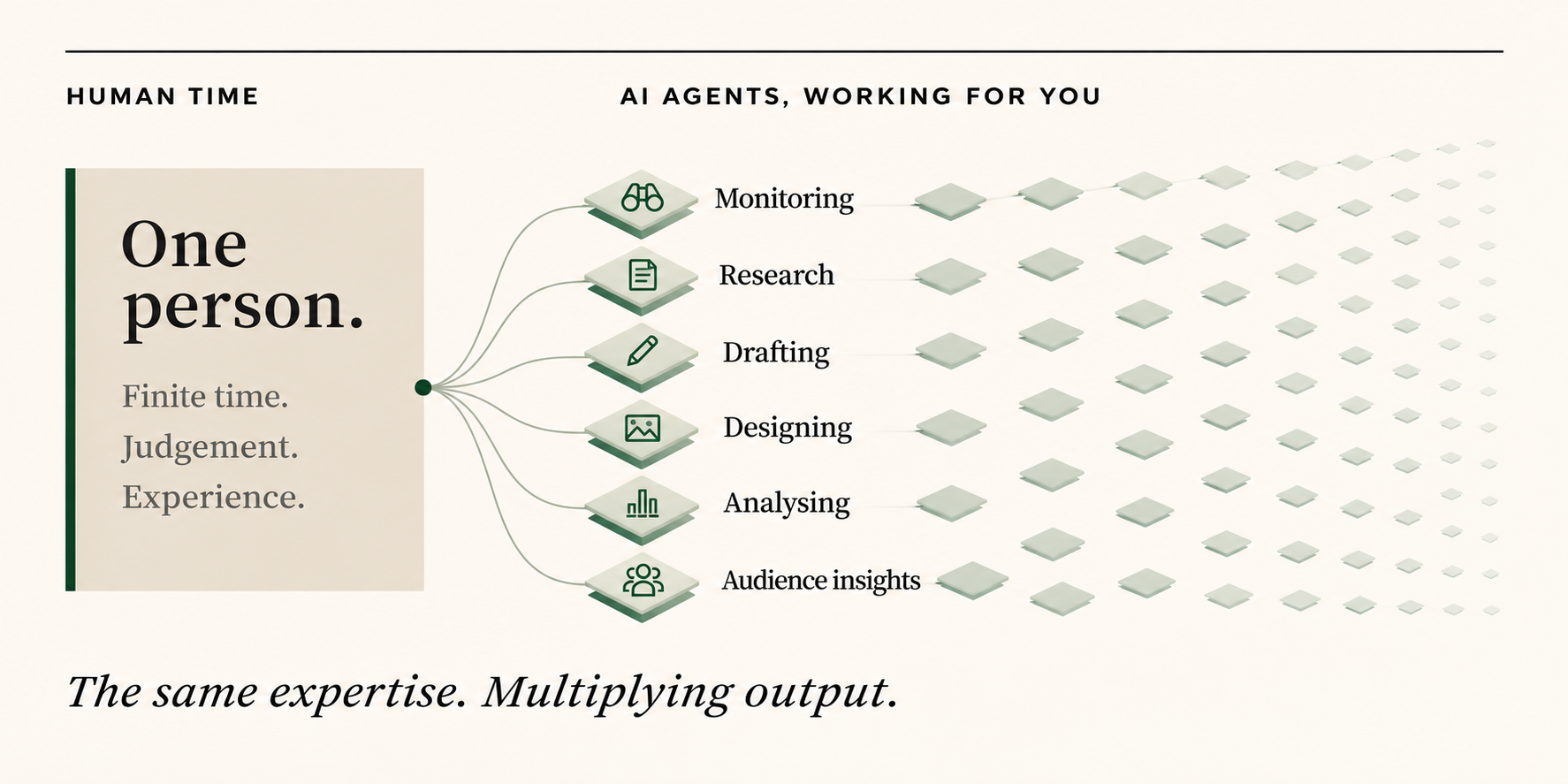
One person.
Finite time. Judgement. Experience.
AI agents, working for you
- Monitoring
- Research
- Drafting
- Designing
- Analysing
- Audience insights
The same expertise. Multiplying output.
The more of us who realise this, the less AI will replace humanity — and the more it will accelerate it.
Most people still think AI means ChatGPT, Claude or Gemini.
They are extraordinary products — but they are only some of the first applications of AI.
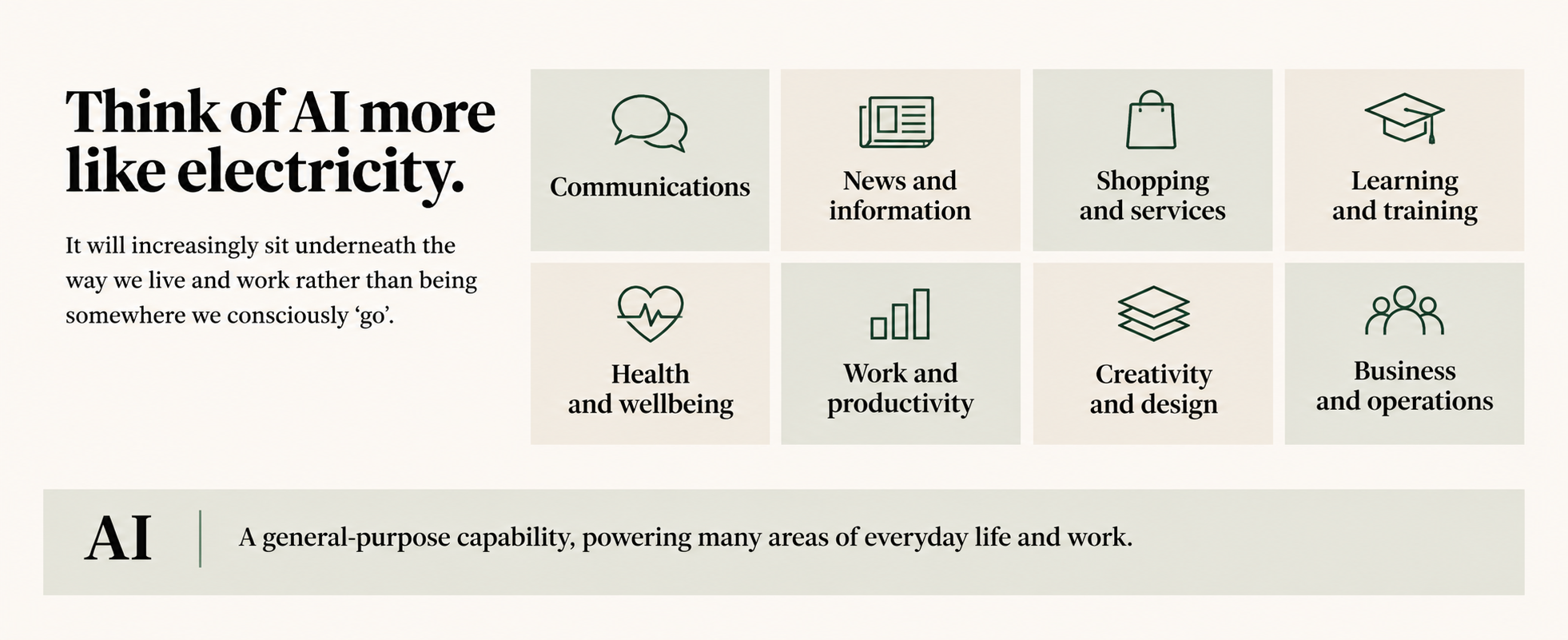
Think of AI more like electricity.
It will increasingly sit underneath the way we live and work rather than being somewhere we consciously ‘go’.
- Communications
- News and information
- Shopping and services
- Learning and training
- Health and wellbeing
- Work and productivity
- Creativity and design
- Business and operations
AIA general-purpose capability, powering many areas of everyday life and work.
The future will be shaped by how quickly people and organisations learn to integrate this new capability into their own lives and businesses.
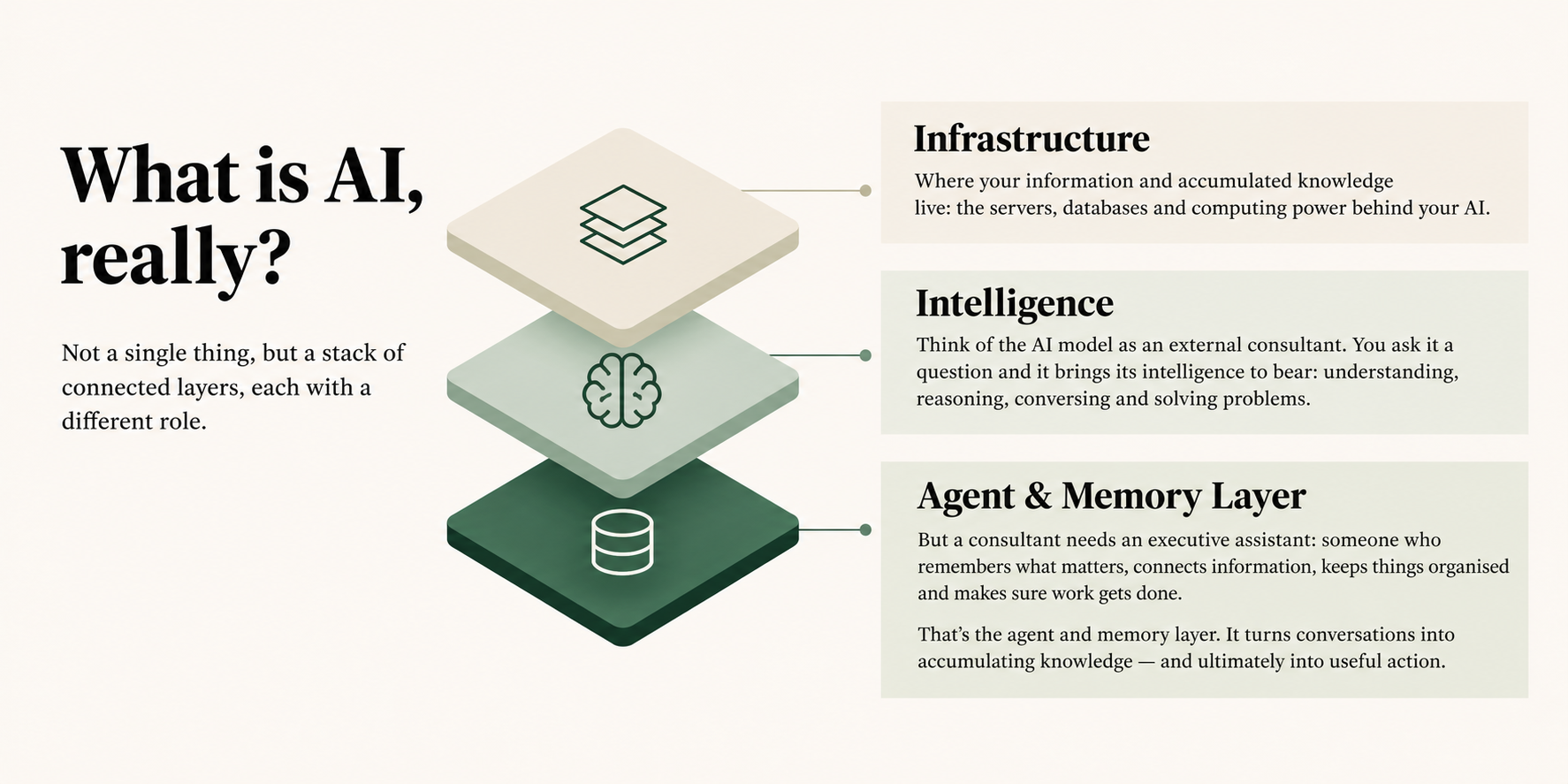
What is AI, really?
Not a single thing, but a stack of connected layers, each with a different role.
Infrastructure
Where your information and accumulated knowledge live: the servers, databases and computing power behind your AI.
Intelligence
Think of the AI model as an external consultant. You ask it a question and it brings its intelligence to bear: understanding, reasoning, conversing and solving problems.
Agent & Memory Layer
But a consultant needs an executive assistant: someone who remembers what matters, connects information, keeps things organised and makes sure work gets done.
That's the agent and memory layer. It turns conversations into accumulating knowledge — and ultimately into useful action.
The model provides the intelligence. The memory makes it yours.
The model provides general intelligence. But the real compounding value comes from the memory built around it — your decisions, methods, relationships, preferences and work. That is how AI begins to become your intelligence — your sovereign asset.
The question for you: do you want to build a memory of your own?
Keep using AI in someone else's world.
You can get extraordinary value from external AI services. But if you simply use them as tools, without deliberately building a memory of your own around them, each interaction remains largely transactional. You are using intelligence, rather than compounding your own.
AI stays external.
More likely to replace people.
Or build a digital home of your own.
Create an environment with your rules, your memory, your priorities and your structure. Then, every time you use AI, you strengthen your own digital memory — an asset that becomes more valuable with every interaction.
You build a digital home of your own.
More likely to accelerate humanity.
The more it remembers, the more useful it becomes.
Over time, it can understand how you or your organisation thinks, works and what it is trying to achieve. Instead of an external adviser who needs repeatedly briefing, you begin to build something closer to an in-house team: always up to date, able to train staff, preserve institutional knowledge, understand objectives and increasingly keep projects moving without waiting for every prompt.
The more we do,
the more we want to do.
Our own experience of integrating AI into our business is not that we have less to do. Quite the opposite. As the limitations on our capacity diminish, our ambitions grow.
Increasingly, when we work with other people, we look for those who have embraced AI to extend their own capabilities.
The opportunity is not simply to reduce the cost of what we already do. It is to fundamentally reconsider what we are capable of doing.
Now imagine
where that leads.
Your expertise no longer has to be available only when you are. It could train your team while you sleep, advise people you will never have time to meet, or be licensed to thousands — even millions — without requiring millions of hours of your time. Used this way, AI does not replace human expertise. It gives human expertise vastly greater reach.